
How to Improve My Smile — and What Another Year of Waiting Actually Costs
Heads up: this article contains affiliate links. If you buy through them, we may earn a commission at no extra cost to you.
If you have been asking yourself how to improve my smile for longer than you care to admit, you are not alone. A lot of men in their 30s and 40s reach that point where they catch themselves in a Zoom call, a first date, or a job interview and think — I really need to do something about this. Then life keeps moving and another year slips by.
This article is not about shame. It is about an honest look at what that delay actually adds up to — in real situations, real money, and real confidence. It also covers the practical steps you can take, starting today, so you have something concrete to work with.
What a Year of Postponing Actually Takes From You
When a smile makes you self-conscious, the cost is rarely one big dramatic moment. It is a slow accumulation of small ones.
You do not lean in for the group photo. You cover your mouth when you laugh. You rehearse what to say before a client meeting but spend part of your mental energy worrying about whether your breath or your teeth will give the wrong impression. That cognitive overhead is real, and it compounds over time.
Sales professionals and managers know that the first ten seconds of a meeting carry disproportionate weight. If part of your brain is managing the anxiety of how your smile looks instead of focusing on the pitch, the relationship, or the conversation, that is a genuine performance cost — not a vanity issue.
On the social side, the same pattern plays out. First dates, networking events, casual conversations with new people — moments where confidence should be your biggest asset. When a smile is a source of anxiety rather than a tool, you show up with one hand tied behind your back.
Another year of that is not neutral. It is a year of slightly smaller versions of those moments.
What You Have Already Spent on Things That Did Not Stick
Most men reading this have not done nothing. You have probably picked up whitening strips at some point. Maybe a whitening toothpaste. Perhaps a water flosser you used for a month. These things add up — a few dollars here, a few pounds there — without producing the kind of change you were hoping for.
That spending feels frustrating in retrospect because the problem was not addressed at a deeper level. Surface whitening products work on surface stains. If your mouth’s underlying environment is out of balance — if the mix of bacteria is not healthy — cosmetic fixes tend to be temporary at best.
That is not to say surface-level care is worthless. It is not. But if you have been throwing money at the symptom without thinking about the environment beneath it, that pattern will just continue into next year.
Free guide
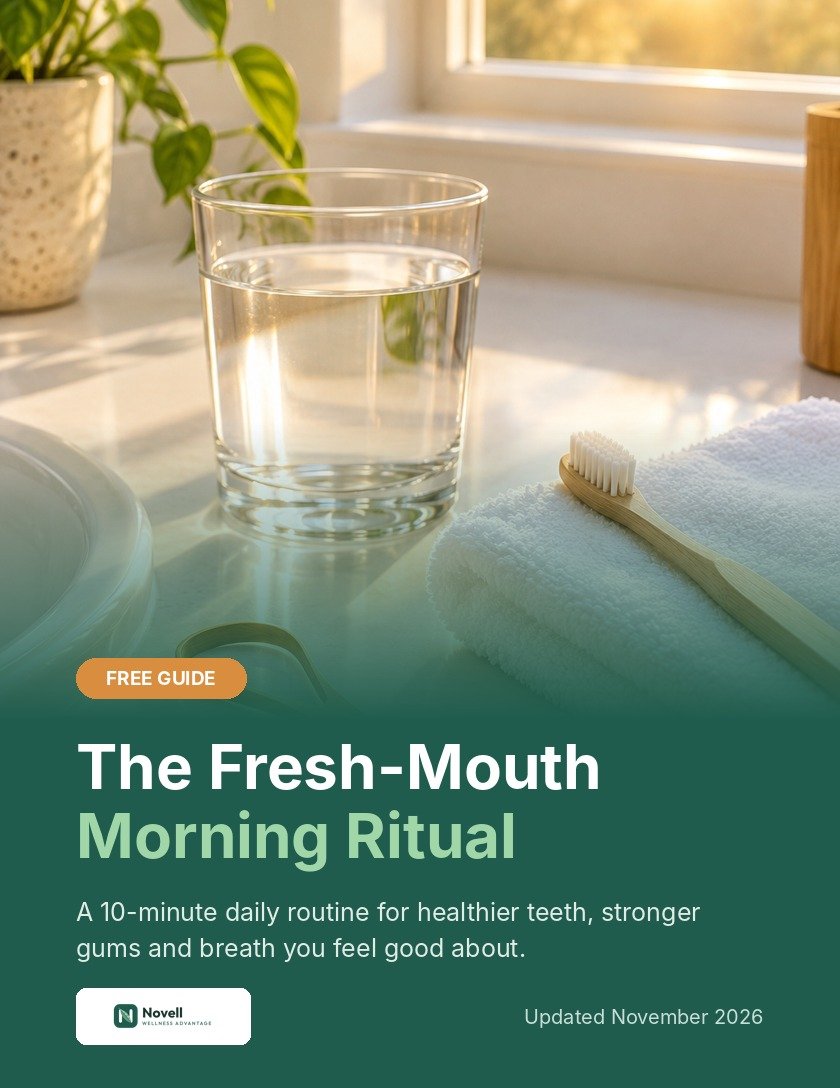
The Fresh-Mouth Morning Ritual: A 10-Minute Daily Routine for Healthier Teeth, Stronger Gums, and Breath You Feel Good About
Download our free 10-minute morning ritual guide and build a simple daily routine that supports your teeth, gums, and breath — no expensive products required. Enter your first name and email and you’ll get it right away.
You’ll get the guide right away, plus a few short tips by email. Unsubscribe any time. Privacy Policy
What Actually Improves a Smile — Starting With the Basics
Before we get into anything more involved, the fundamentals matter more than most people give them credit for. If your daily habits are inconsistent, no cosmetic upgrade will hold.
Brushing — Guidance from the Mayo Clinic recommends brushing gently twice a day for around two minutes, covering the gumline and your tongue — not just the visible front surfaces of your teeth. Most people spend far less time than that and skip the gumline entirely.
Flossing — Cleaning between your teeth daily removes what a toothbrush cannot reach. This matters as much for gum appearance and breath freshness as it does for cavities.
Technique — Brushing too hard can wear down enamel over time and damage the gumline. Firm is not better. Consistent and thorough is better.
If your answer to ‘how to improve my smile’ has mostly involved products rather than habits, this is the foundation you are building on. Without it, nothing else works as well as it should.
Understanding What Kind of Discoloration You Are Dealing With
Not all tooth discoloration is the same, and this is a gap most articles gloss over. Surface staining from coffee, tea, or certain foods responds to whitening products. Internal changes to the tooth structure do not. Decay, mineral changes, and certain medications affect tooth colour differently, and those require a dentist’s assessment — not a whitening strip.
If you have tried standard whitening approaches without results, that is a signal worth paying attention to. It may mean the discoloration is not on the surface, and cosmetic approaches will keep disappointing you until someone looks at the underlying cause.
The same logic applies to gum appearance. Gums that look red, that bleed when you brush, or that sit lower than they used to are telling you something about your mouth’s environment — not just about whether you floss enough.
Cosmetic Options Worth Knowing About
Once your daily habits and gum health are in order, there is a range of cosmetic dental options for specific concerns:
Whitening — Professional in-chair treatments are faster and more consistent than at-home products. Take-home trays from a dentist use higher concentrations than over-the-counter strips and are custom-fitted, which makes a difference.
Bonding — A tooth-coloured resin applied to chips, small gaps, or surface irregularities. It is one of the more affordable cosmetic procedures, usually completed in a single visit, and does not require removing tooth structure.
Veneers — Thin porcelain or composite shells bonded to the front of teeth. More comprehensive than bonding and longer-lasting, but they require removing a small amount of enamel, which makes the choice permanent. They are not suitable for everyone.
Crowns — Used when a tooth is significantly damaged or discoloured beyond what bonding or a veneer can address. More involved than either, but they restore function as well as appearance.
Orthodontics — Crooked or crowded teeth are increasingly addressed with clear aligner systems, which are less visible than traditional braces. This is a longer-term investment measured in months, not a quick fix, but for alignment issues it is the route that actually solves the problem.
One thing these options have in common: they all work better when the gum and oral health foundation beneath them is solid. A cosmetic result on an unhealthy oral environment will not last.
The Oral Microbiome: What Most Smile-Improvement Articles Skip
This is where the conversation has been evolving in recent years, and it is worth understanding even if it is not front and centre in most grooming or lifestyle content.
The health of your gums and the freshness of your breath are not just about mechanical cleaning. Research has pointed to the balance of bacteria in the mouth — the oral microbiome — as a meaningful factor in overall oral health. A mouth with a healthy population of beneficial bacteria tends to maintain a healthier environment for both teeth and gums.
This is relevant to anyone who brushes consistently but still notices gum tenderness, persistent breath issues, or teeth that do not look as healthy as they expect. The mechanical habits are right; something in the environment may not be.
That is the thinking behind probiotic-based oral health supplements, which have emerged as a category worth knowing about. ProDentim is one such product — a chewable supplement containing, according to the vendor, 3.5 billion probiotic bacteria across strains including Lactobacillus Paracasei, B.lactis BL-04, and Lactobacillus Reuteri, alongside a proprietary blend of four plant and mineral ingredients including inulin, malic acid from strawberries, tricalcium phosphate, and peppermint. The stated purpose is to support the balance of bacteria in the mouth and promote a healthier environment for gums and teeth.
The vendor describes it as a natural, non-GMO, gluten-free formula without stimulants. The vendor states it is manufactured in an FDA-registered facility. And according to the vendor, it comes with a 60-day money-back guarantee, which the vendor states removes most of the financial risk if you want to try it as part of a broader approach to your oral health.
This is not a cosmetic fix. It does not replace brushing, flossing, or a dentist visit. But if the foundation of your mouth’s bacterial environment has been working against you, it is a different category of support than anything that sits on a surface.
Confidence in Photos and in the Room
One last thing that rarely gets addressed in smile improvement content: the gap between fixing a dental issue and actually smiling with confidence again.
For a lot of men, the self-consciousness has been there long enough that it becomes a habit — covering the mouth, closed-lip expressions, pulling back when a camera comes out. Even after oral health improves, that behavioural pattern can persist.
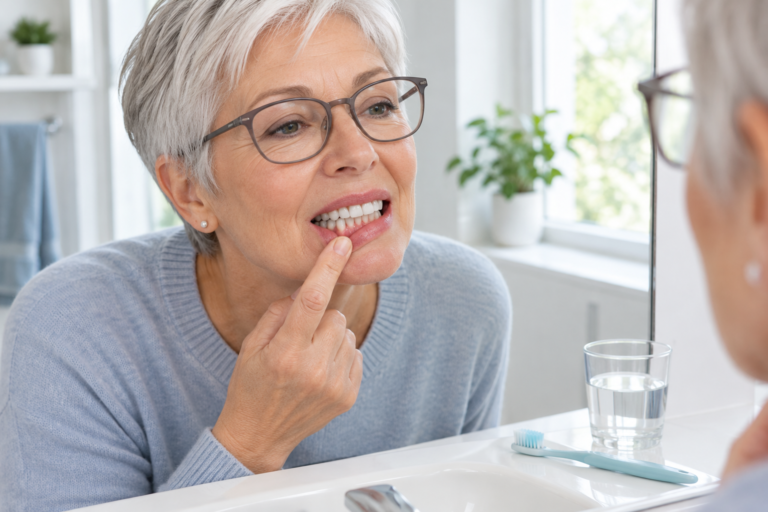
This is worth being deliberate about. Practice an open smile in a mirror. Pay attention to relaxing your jaw and face rather than tensing them. Notice where your posture is when you are talking versus when you feel uncomfortable — the two are connected. Confidence in a smile is partly about how the smile looks, but it is also partly about how much you have practised showing it.
Another year of hiding it is a year of reinforcing that habit. The sooner the dental foundation improves, the sooner the confidence can follow.
The Bottom Line
If you have been searching for how to improve my smile and walking away without acting, the question to sit with is not ‘what is the perfect solution’ — it is ‘what is the cost of not starting anything this year?’
That cost is real. It shows up in meetings, in photos, in first impressions, in money already spent on things that did not address the root cause. The good news is that the path forward is not one big expensive commitment. It is a layered approach: nail the daily habits, understand what kind of problem you are actually dealing with, consider what cosmetic or professional options are relevant, and think about whether the microbiome layer of support makes sense for where you are.
Any of those steps taken this week is better than another twelve months of the same.
If the microbiome side of this article caught your attention, you can read more about ProDentim — including how it works and what is in it — on our product page.
Visit the ProDentim product page at Novell Wellness Advantage:
The page covers the full ingredient list, the 60-day money-back guarantee, and how the product is intended to fit into a daily oral health routine. No subscription traps. No complicated process.
Disclosure: This article contains affiliate links. If you purchase through them, we may earn a commission at no additional cost to you.
Medical Disclaimer. The content on this site is for informational purposes only and is not medical advice. It is not a substitute for professional diagnosis or treatment. Always consult a qualified healthcare provider before starting any supplement, especially if you have a medical condition or take medication.
FDA Structure-Function Statement. These statements have not been evaluated by the Food and Drug Administration. This product is not intended to diagnose, treat, cure, or prevent any disease.