
Sex Tips for Men: 4 Common Beliefs That Are Wrong
Heads up: this article contains affiliate links. If you buy through them, we may earn a commission at no extra cost to you.
If you have searched for sex tips for men at any point in the last decade, you have encountered a lot of the same material recycled endlessly. Performance checklists. Technique breakdowns. Lists of positions.
Most of it is not wrong exactly. It is just incomplete — and in some cases it repeats ideas that quietly lead men in the wrong direction. After 50, in particular, those ideas can create unnecessary frustration.
This article is not a technique guide. It is a correction. Here are four widely repeated beliefs about male intimacy that deserve a closer look — and what a clearer picture actually says.
Myth 1: Confidence Is a Starting Point, Not Something You Build
One of the most common pieces of advice given to men is simply to ‘be confident.’ It is presented as if confidence is a switch you flip — a mindset choice available to anyone who wants it badly enough.
In practice, confidence in intimate situations is not a character trait you either have or lack. It is something that tends to follow from feeling comfortable in your own body. When a man is rested, physically at ease, and not preoccupied by background worries — bathroom urgency, disrupted rest the night before, low energy — he is more naturally at ease in close moments with a partner.
Telling men to ‘just be confident’ skips the more useful question: what is making you uncomfortable, and is any of it addressable?
Men who address the physical factors quietly undermining their sense of ease often find that confidence follows on its own, without anyone having to instruct them to perform it.
Myth 2: Lasting Longer Is the Primary Goal
An enormous amount of content aimed at men treats duration as the central measure of a satisfying experience. The longer, the better — full stop.
This belief creates a specific kind of pressure that often works against the thing it is supposed to help. When a man is mentally preoccupied with managing timing, he is not fully present with his partner. And presence — genuine attention, responsiveness, the sense of being actually there together — is what most partners describe as meaningful, not duration alone.
Beyond that, the focus on duration leaves out what many partners consistently say matters more: attentiveness before and during, unhurried connection, and the willingness to pay attention to feedback rather than follow a predetermined script.
Duration is one variable among many. Treating it as the defining measure sets men up to feel like they failed even when their partner did not experience the encounter that way at all.
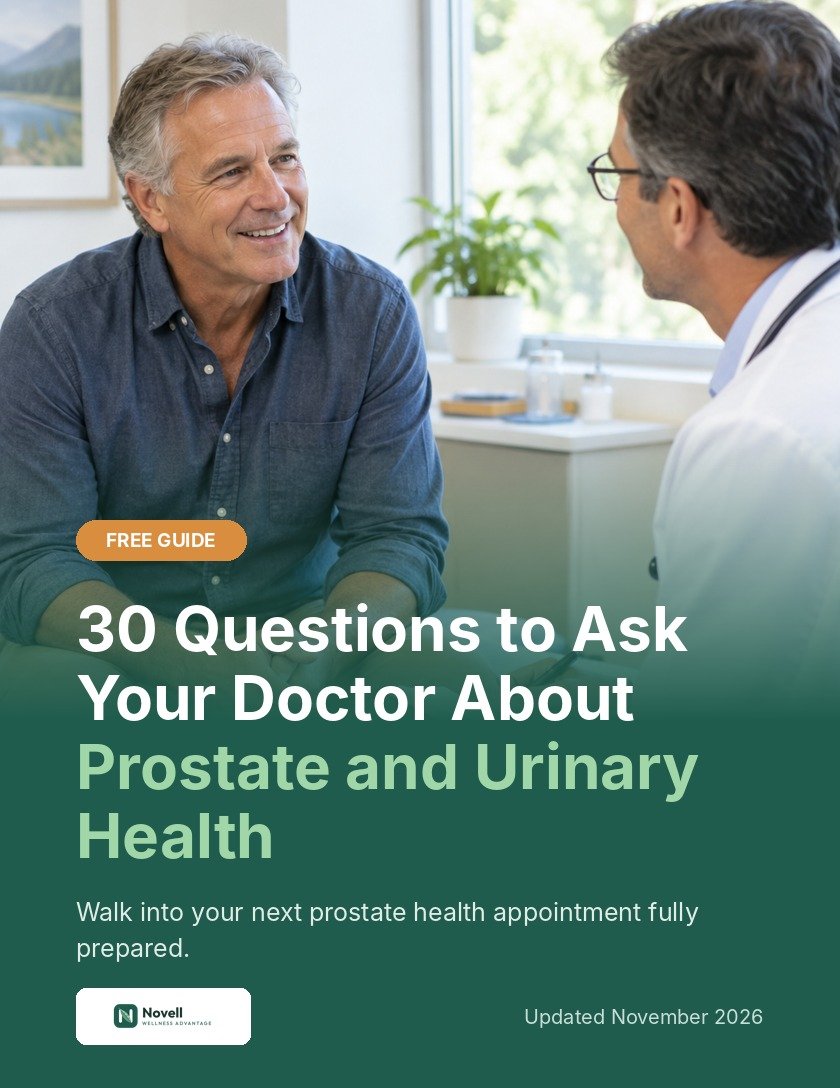
Free guide
30 Questions to Ask Your Doctor About Prostate and Urinary Health
Download our free 30-question guide and walk into your next prostate health appointment fully prepared. Enter your first name and email and you’ll get it right away.
You’ll get the guide right away, plus a few short tips by email. Unsubscribe any time. Privacy Policy
Myth 3: Talking About It Kills the Mood
There is a persistent idea in popular culture that discussing what you want, what your partner wants, or how things are going represents some kind of intimacy-breaking interruption. Real passion, the myth goes, is nonverbal and intuitive.
This is not supported by what couples actually report. Partners who communicate openly — before, during, and after — consistently describe more satisfying experiences than those who operate on assumption. That is not a surprising finding once you think about it. Two people cannot read each other’s minds, and bodies change over time.
For men over 50 especially, comfort levels, preferences, physical responses, and what feels good may have shifted from what they were at 35. The same is true for partners. The assumption that everything should be understood without discussion is not romance — it is guesswork, and guesswork produces worse outcomes than a straightforward, good-natured conversation.
Learning to have those conversations without awkwardness is itself a skill, and it is one of the most genuinely useful sex tips for men that rarely gets the attention it deserves.
Myth 4: Physical Changes After 50 Are Just Decline — Accept Them
The fourth myth is perhaps the most damaging, because it encourages passivity at the moment when a more curious, proactive approach would actually help.
The standard cultural message to men over a certain age is: things change, that is natural, adjust your expectations and move on. Some version of that is true — the body at 60 is not identical to the body at 30, and accepting that honestly is part of emotional maturity.
But ‘accepting change’ and ‘assuming nothing can improve’ are not the same thing. Many of the factors that affect intimate vitality, energy, ease, and comfort are influenced by daily habits, what a man eats, how well he rests, and the degree to which his overall circulatory and physical wellbeing is being supported.
Blood flow matters throughout the body. Rest quality affects everything from mood to physical readiness. Energy levels shape whether intimacy feels like a pleasure or a chore. These are not areas where men simply have no leverage after a certain age — they are areas where consistent, thoughtful attention to daily habits can make a real difference.
The men who quietly write off this decade of their lives as ‘past it’ often do so without having genuinely explored what lifestyle and nutritional support might do for them. That is not acceptance of reality. That is an incomplete inquiry.
What This Actually Points To
All four of these myths share a common flaw: they oversimplify. They treat confidence, duration, communication, and physical change as fixed facts rather than as things that respond to attention and care.
The more honest framework looks like this:
- Confidence follows physical comfort, rest, and ease — it is a byproduct, not a prerequisite.
- Presence and attentiveness matter more to most partners than any single performance variable.
- Open, unhurried conversation is not a passion-killer — it is one of the most reliable intimacy-builders available.
- Physical vitality at 55 or 65 is shaped by daily choices, not sealed by age.
If any of this sounds relevant to where you are right now, the most useful next step is not another technique article. It is an honest look at how you are sleeping, how your energy is holding up day to day, and whether the physical foundation — including prostate comfort and urinary ease at night — is being supported as well as it could be.
Those factors do not get discussed in most intimacy articles aimed at men. They probably should be.
If you are curious about natural nutritional support for prostate comfort, restful nights, and the kind of daily vitality that shows up everywhere in a man’s life, our product page walks through one option worth knowing about.
Visit the product page here:
Disclosure: This article contains affiliate links. If you purchase through them, we may earn a commission at no additional cost to you.
Medical Disclaimer. The content on this site is for informational purposes only and is not medical advice. It is not a substitute for professional diagnosis or treatment. Always consult a qualified healthcare provider before starting any supplement, especially if you have a medical condition or take medication.
FDA Structure-Function Statement. These statements have not been evaluated by the Food and Drug Administration. This product is not intended to diagnose, treat, cure, or prevent any disease.