
Knee Joint Pain While Folding: 4 Beliefs Worth Questioning
Heads up: this article contains affiliate links. If you buy through them, we may earn a commission at no extra cost to you.
If you have ever felt that familiar sharp ache the moment you bend your knee — getting down to the garden, kneeling on the floor with a grandchild, or simply folding your legs under you on the couch — you are far from alone. Knee joint pain while folding or bending is one of the most searched health complaints among women in their 60s and 70s. And yet, the information most people find is either scattered across a list of scary conditions or oversimplified to the point of being useless.
What makes this frustrating is not a lack of information. It is that several widely repeated beliefs about why this happens are simply wrong — or incomplete enough to send you in the wrong direction. Let’s correct the record on four of the most common ones.
Belief 1: ‘Pain When You Bend Means Your Cartilage Is Worn Away’
This is probably the most common fear people carry around. The story goes: knees hurt because years of use have ground the cartilage down to nothing, and once it is gone, that is it.
The truth is more nuanced. Cartilage changes with age, but pain and cartilage condition do not map onto each other as neatly as this belief suggests. Some people show significant cartilage changes on imaging and feel very little discomfort. Others feel sharp pain during bending with cartilage that looks relatively intact. The experience of pain involves far more than tissue structure alone — the fluid environment inside the joint, the state of the surrounding soft tissue, and how well the joint is lubricated all play a role.
In other words, writing off your knee as ‘worn out’ based on this belief alone may cause you to give up on approaches that could genuinely help — before you have even tried them.
Belief 2: ‘Pain When Bending Is All the Same Problem’
Many articles treat knee pain during bending as a single issue with a single cause. It is not. Where the pain sits and when it appears tell very different stories.
Pain at the front of the knee that worsens when you first begin to fold, then eases as you move, often points to something very different from pain that builds at the back of the knee after sitting for a long time. Pain that arrives at the deepest point of a bend — say, fully kneeling to tend to a flower bed — differs again from pain that shows up climbing stairs or rising from a chair.
The timing matters too. Is it worst first thing in the morning? After long periods of sitting still? Only after certain activities? Each pattern carries its own meaning. Collapsing all of these into one label means the approach you take may not actually address what is driving your specific discomfort.
If your symptoms include significant swelling, the knee feeling hot or red, locking or catching in place, or you experienced a sudden pop before the pain started, talk with a healthcare professional — those are signs that deserve a proper evaluation rather than a wait-and-see approach.
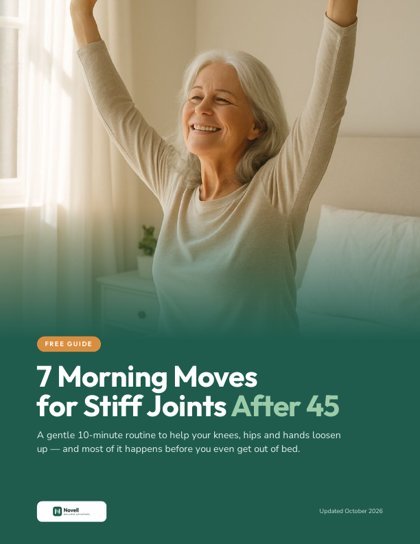
Free guide
7 Morning Moves for Stiff Joints After 45
A gentle 10-minute routine for knees, hips and hands — most of it done before you even get out of bed. Enter your first name and email and you’ll get it right away.
You’ll get the guide right away, plus a few short tips by email. Unsubscribe any time. Privacy Policy
Belief 3: ‘The Right Answer Is to Rest Until It Passes’
Rest has its place. If you have just strained your knee or the joint is acutely inflamed, stepping back from movements that worsen the pain is sensible short-term advice. But rest as an indefinite strategy often makes things worse, not better.
Knees are joints designed for movement. The cartilage inside a joint does not have its own blood supply the way most tissue does. It receives nutrients partly through the compression and release that happens during movement — a process sometimes compared to squeezing a sponge. Extended inactivity can interfere with that process and stiffen the surrounding muscles and connective tissue, which then places more stress on the joint when you do eventually move again.
The goal, once acute symptoms settle, is typically not rest — it is the right kind of movement. Gentle, low-impact activity chosen carefully is generally far more supportive for knee health over time than simply waiting it out on the couch.
This distinction matters enormously for women in their 60s and beyond, because the instinct to protect a painful joint by moving less can quietly accelerate the very changes that make the pain worse.
Belief 4: ‘Clicking and Popping Means Something Is Torn’
The sound a knee makes when you fold it can be alarming. Many people hear a click, a pop, or a soft grinding noise and immediately assume serious structural damage.
In the majority of cases, clicking or popping during bending — particularly when it is painless — is not a sign of injury. Joints can produce sounds for a variety of reasons that have nothing to do with tears or damage. Gas releasing from the joint space, tendons shifting slightly over bony surfaces, and normal variation in joint mechanics can all create noise without any harm.
The situation worth paying attention to is different: a click or pop that happens alongside sudden pain, swelling, or a feeling of instability — especially if it followed a specific incident like a twist or a fall. That combination deserves professional attention. But painless joint sounds on their own, in the absence of swelling or instability, are generally not the warning sign they are assumed to be.
What Research Is Pointing Toward
One area of joint health research that has grown considerably in recent years focuses not just on cartilage structure but on the fluid environment inside the joint itself — specifically, the role of the synovial fluid that cushions, hydrates, and nourishes the joint from the inside.
Research has suggested that this fluid can change in quality as we age, and that those changes affect how well the joint moves and how comfortable it feels during bending and folding movements. This is a relatively newer lens through which scientists are examining age-related joint concerns — and it is one that shifts attention away from pure cartilage loss toward the broader ecosystem of the joint.
Whether this line of thinking translates into meaningful practical options is something researchers continue to explore. But understanding it at least helps explain why the ‘cartilage is worn away’ story is an oversimplification — and why the same joint, with the same structural picture on imaging, can feel very different depending on what else is happening inside it.
A More Useful Way to Think About This
If knee joint pain while folding is limiting what you can do — getting to the floor with grandchildren, kneeling in the garden, climbing in and out of the car — the starting point is not to accept it as an inevitable sentence. It is to get clearer on what is actually driving it.
That means paying attention to location, timing, and pattern rather than assuming a single cause. It means being honest with a healthcare professional if the pain is persistent, getting worse, or affecting daily activities. And it means being cautious about any single explanation that claims to cover all knee pain in all people.
Understanding what is actually happening — rather than acting on beliefs that may not apply to your situation — is the foundation of any approach that is genuinely going to help.
If you have been reading about joint fluid and what research suggests about supporting the joint environment from the inside, there is a product page on our site that walks through one specific formula developed with that focus in mind.
According to the vendor, it is built around an ingredient shown in clinical research to support hyaluronan levels in the synovial fluid — the substance that gives that fluid its natural thickness and lubricating quality — combined with other research-backed ingredients. The page explains the science behind the formula clearly, without hype.
If that sounds worth a few minutes of your time, you can read the full product page here.
Disclosure: This article contains affiliate links. If you purchase through them, we may earn a commission at no additional cost to you.
Medical Disclaimer. The content on this site is for informational purposes only and is not medical advice. It is not a substitute for professional diagnosis or treatment. Always consult a qualified healthcare provider before starting any supplement, especially if you have a medical condition or take medication.
FDA Structure-Function Statement. These statements have not been evaluated by the Food and Drug Administration. This product is not intended to diagnose, treat, cure, or prevent any disease.