
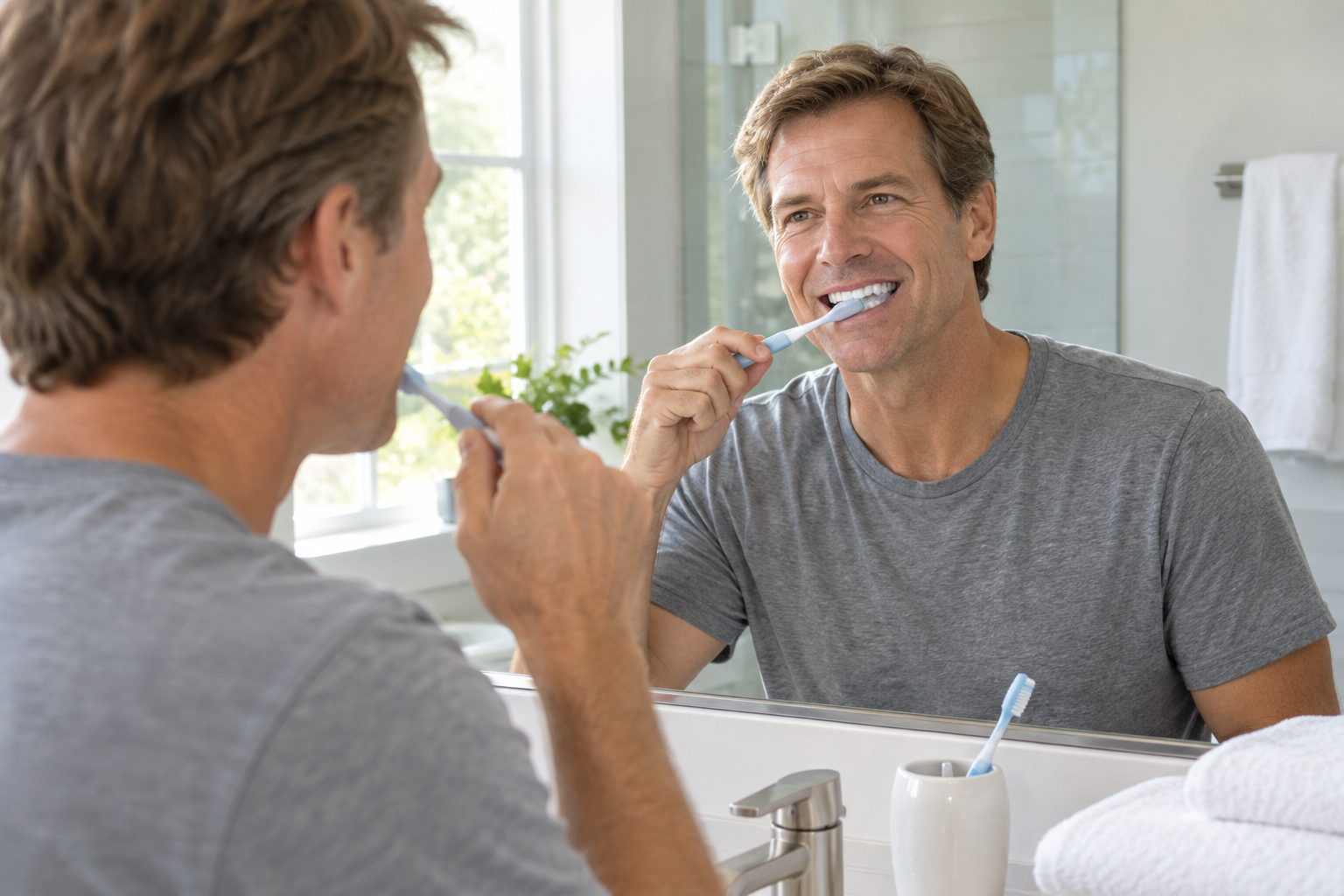
Teeth Are Yellow: Why Men Hide It and How to Finally Say Something
If your teeth are yellow, there is a good chance you have not said a word about it to anyone — not your partner, not your kids, not your closest mate at work. You have just quietly started angling yourself away from photos, laughing with your mouth a little more closed, and telling yourself it is not that big a deal.
It is a big deal. Not because yellow teeth mean something is seriously wrong — in many cases they do not — but because the silence costs more than the problem itself.
This article is about that silence. Why men carry this one alone, what it does to the people around them, and how a real conversation about it might actually go.
Why Yellow Teeth Hit Differently for Men in Their 30s, 40s, and 50s
Women talk about their skin, their hair, their teeth. There are whole conversations in friend groups and comment sections about what works and what does not. Men tend not to have those conversations. So when something like yellow teeth color becomes a source of embarrassment, there is nowhere to put it.
You notice it in the mirror. You think about it before a sales meeting or a first date. You run your tongue over your teeth before you smile. And then you say nothing, because saying something feels like admitting you care about how you look — which, somehow, still feels like it is not supposed to matter to you.
But it does matter. And everyone around you already knows it matters, even if they are not saying it either.
What the People Close to You Are Actually Noticing
Here is the part that might sting a little: your partner has probably noticed. Your adult kids may have noticed. Your colleagues almost certainly have.
That does not mean they are judging you. Most people who care about you are not thinking less of you because of it. But they may have already wondered whether to say something — and decided not to, for the same reason you have stayed quiet. Nobody wants to be the one who brings it up.
This creates a strange dynamic. You are quietly embarrassed. The people who love you are quietly watching you be embarrassed. And nobody says anything, which just makes the whole thing heavier over time.
The Most Common Reason Men Do Not Bring It Up
The conversation most men dread sounds like this in their head: they imagine saying ‘I am embarrassed about my teeth’ and getting back either pity or a lecture about seeing a dentist more regularly. Neither feels good.
So instead, they manage around it. They do not smile as wide in group photos. They pop a mint before close conversations. They avoid certain foods in public not because of taste but because of how it looks. They spend energy managing perception rather than addressing the actual thing.
That is exhausting. And it is invisible work that nobody else sees.
How to Actually Start the Conversation — Without It Being Awkward
If you have a partner, the easiest version of this conversation is also the most honest one. You do not need to build up to it or frame it as a confession. You can just say what is true.
Something like: ‘I have been a bit self-conscious about my teeth lately. I am not sure what to do about it but it is on my mind.’ That is it. You do not need to justify why it matters or explain how long it has been bothering you. Just name it.
Most partners will respond to that with something supportive rather than something critical. And the relief of having said it out loud is real.
With adult kids, the conversation might go differently. They may actually be the ones to bring it up first — younger adults are often more comfortable in this territory. If they do, resist the instinct to brush it off with a joke. A simple ‘yeah, I have been thinking about that’ opens a door instead of closing it.
Why Teeth Turn Yellow — and What Is Actually in Your Control
A quick grounding note here, because part of what makes this hard to talk about is not knowing whether the cause is something you did or just something that happens.
The honest answer is: often both. Surface staining from coffee, tea, red wine, and years of use is extremely common and very much normal. Enamel also naturally becomes thinner over time, which can make the yellowish layer beneath it more visible. That is not a hygiene failure — it is just how teeth change with age.
What is in your control: limiting the habits that accelerate surface staining, maintaining consistent brushing and care, and looking at what else you can do to support the overall health of your mouth — not just the color.
What is not in your control: genetics, how your enamel was formed, discoloration that started during childhood, or natural color shifts that come with age. Talking to a dentist is always worth doing if you are unsure which category your situation falls into, especially if the change has been sudden or involves a single tooth.
The Yellow Teeth Color Conversation Nobody Is Having — But Should Be
The deeper issue with teeth yellow discoloration is not really about cosmetics. It is about what happens to confidence over time when something small and fixable becomes a source of ongoing shame.
Men in sales, management, and client-facing roles especially feel this. Your smile is one of the first things people read. Not because they are looking for perfection, but because it signals ease and openness. When you are holding your smile back, people can feel that something is slightly off — even if they cannot name it.
Talking to the people close to you about this does two things. It removes the weight you have been carrying alone. And it opens the door to actually doing something about it, which is a lot easier when you are not pretending the problem does not exist.
What to Look for if You Decide to Do Something About It
If you are researching options beyond whitening strips and cosmetic treatments, one area that has been getting more attention is oral health from the inside — specifically, the role of good bacteria in keeping your mouth environment healthy.
The thinking behind this is straightforward: a healthy mouth is not just about what you brush off the surface. The bacterial balance in your mouth matters for gum health, freshness, and the overall condition of your teeth. Supporting that balance is a different approach from traditional whitening, and it appeals to a lot of men who are interested in the optimization angle — taking care of the system, not just the appearance.
ProDentim is one product in this space. It is a chewable daily supplement containing 3.5 billion probiotic strains — including Lactobacillus Paracasei, B. lactis BL-04, and Lactobacillus Reuteri — along with a proprietary blend that includes malic acid from strawberries, which is noted for helping maintain tooth whiteness, and peppermint, a natural option with a long history of use for freshness. It also contains inulin, which supports good bacteria, and tricalcium phosphate for tooth support.
It is not a whitening treatment and it is not a replacement for dental care. But if you are someone who thinks about your health systematically and wants to do more than just manage symptoms on the surface, it is worth looking at how the product is positioned and what it is designed to do.
The Real Win Is the Conversation, Not Just the Fix
Whatever you decide to do about your teeth, the bigger shift is letting someone in. The men who talk to their partners or their kids about something like this do not look weaker for it. They look like someone who takes himself seriously enough to deal with things rather than carry them quietly.
That is a different kind of confidence — and it tends to show up in a smile.
If you are curious about ProDentim and what the probiotic approach to oral health actually involves, the product page at Novell Wellness Advantage walks through the ingredients, how it works, and what comes with an order.
Visit the product page here:
There is a 60-day money-back guarantee on every order, so there is no financial risk to trying it.
Disclosure: This article contains affiliate links. If you purchase through them, we may earn a commission at no additional cost to you.
Medical Disclaimer. The content on this site is for informational purposes only and is not medical advice. It is not a substitute for professional diagnosis or treatment. Always consult a qualified healthcare provider before starting any supplement, especially if you have a medical condition or take medication.
FDA Structure-Function Statement. These statements have not been evaluated by the Food and Drug Administration. This product is not intended to diagnose, treat, cure, or prevent any disease.